 Nova Hair
 Hair Extension Methods Compared: Which Suits Your Client
Every extension method is a trade-off between install speed, how long it stays in, how many times the hair can be reused, and how much sustained tension it puts on the client’s scalp. There is no single best method. There is only the best method for a given head of hair, a given budget, and a given maintenance schedule. If you supply salons and resellers, knowing those trade-offs cold is what lets you recommend hair instead of just shipping it.
Quick answer: which method for which client?
For fine or thinning hair, tape-ins and hand-tied wefts lay flattest and spread weight across a wider area. For dense or coarse hair that can hide individual bonds, keratin tips and micro-links blend well. For clients who want zero commitment and the lowest damage risk, clip-ins win because they come out every night. Every attached method still applies pulling tension, so rotation and rest periods matter.
What are the main types of hair extensions?
There are six methods worth knowing, and they split into two families: strand-by-strand and weft. Strand-by-strand methods attach small sections of hair individually, which includes keratin tip fusion extensions (U-tip and I-tip) and micro-link or nano-ring beads. Weft methods attach a horizontal strip of hair, which includes tape-ins, hand-tied wefts, machine wefts sewn into a braid, and clip-ins that snap in and out.
The distinction matters for your buyers because it drives everything downstream: chair time, the tools a stylist needs, how the weight sits on the scalp, and how many times a set can be reinstalled before it retires. A salon that mostly serves fine-haired clients will reorder different SKUs than one built around thick-hair installs.
How do keratin tips (I-tip and U-tip fusion) work?
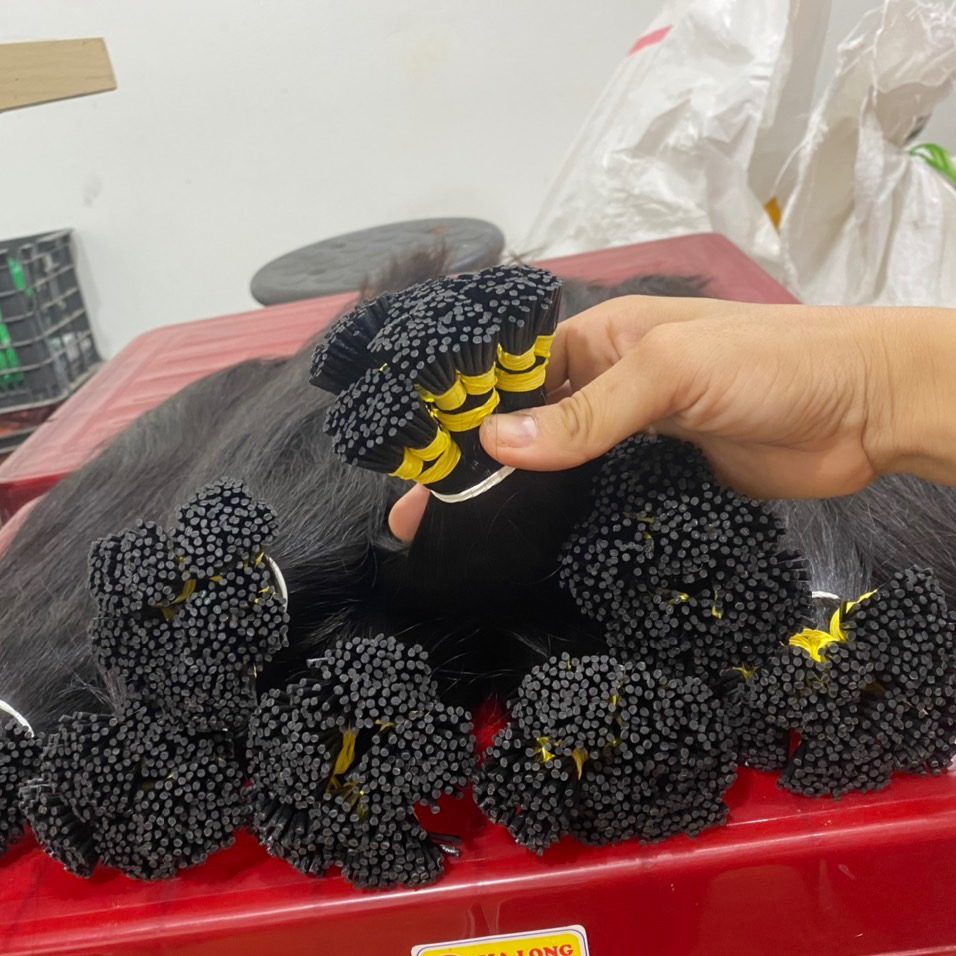
Keratin fusion attaches hair strand by strand using a small keratin bond at the root. U-tips (also called nail tips) are heat-bonded: the stylist melts the keratin against a section of natural hair. I-tips are secured cold, clamped inside a micro-bead, no heat involved. A full head typically runs 100 to 180 strands and takes around 3 to 4 hours to install, though strand count and time vary with head size and the stylist’s speed.
Worn time is roughly 3 to 4 months per install as an industry convention, after which the bonds have grown 2 to 3 inches down from the scalp and the set needs professional removal. Removal means dissolving the keratin with a solution, not pulling. This is a higher-tension method because the bonds carry sustained weight for months at a time, so it suits clients with enough density to anchor the bonds comfortably.
How do tape-in extensions work?
Tape-ins sandwich a thin section of natural hair between two adhesive wefts. Install is fast, usually around 1 to 2 hours, and the flat tape sits close to the scalp, which is why stylists reach for tape-in extensions on fine and medium hair. The weight spreads across the tape’s surface instead of hanging from a single point.
Stylists typically reposition tape-ins every 6 to 8 weeks as the natural hair grows out and the tapes drift away from the scalp. This is a stylist convention, not a medical rule. The same hair can often be re-taped 3 to 4 times, which stretches a set to roughly 6 months of service before it retires. For resellers, that reusability is the selling point: one sale plus recurring tape sales and re-taping appointments. Super double drawn hair holds up best here because the ends stay thick through repeated removals.
How do hand-tied and machine wefts differ?
Hand-tied and machine wefts are both horizontal strips of hair, but they are built differently and behave differently on the head. A hand-tied weft is thin, has no thick seam, and lays almost flat against the scalp, which makes it a favorite for fine-to-medium hair and beaded-row installs. A machine weft is sewn on a machine into a single continuous seam. It is thicker, more durable, and can be cut to length without unraveling much, which suits thick or coarse hair and traditional sew-ins.
Both are installed onto a foundation of beads and thread (a beaded row) or sewn into a braid, and both are moved up every 6 to 8 weeks as industry convention to follow the client’s growth. With professional maintenance a weft set can be reused for roughly 6 to 12 months. The practical buyer takeaway: stock hand-tied for salons doing lightweight, natural-looking rows, and machine weft for volume and coarse-hair durability. Do not let buyers conflate the two, because the wrong choice shows up as bulk at the root or a seam that will not hide.
How do micro-link and nano-ring extensions work?
Micro-links attach individual strands using a small metal or silicone-lined bead clamped onto the natural hair, with no heat, glue, or braiding. Nano-rings are the same idea at a smaller bead size for finer sections. Install runs roughly 2 to 4 hours. Maintenance, meaning the beads are opened and repositioned as the hair grows, is needed every 6 to 8 weeks by industry convention, and the hair itself can be reused for roughly 6 to 12 months with care.
Vendors often market beads as “damage-free” because there is no chemical or heat. Be careful repeating that. The beads still clamp onto the hair and hold sustained weight, so dermatologically this sits among the higher-tension methods, not the safe-by-default one. The honest positioning is “no heat or adhesive,” not “no risk.”
How do clip-in extensions work?
Clip-ins are wefts with pressure-sensitive clips that snap into the natural hair in minutes and come out at the end of the day. No tools, no heat, no adhesive, no salon appointment. Because they are removed daily, clip-ins and ponytails carry the lowest traction risk of any method, and the American Academy of Dermatology specifically advises removing clip-ins before washing (and, per general guidance, before sleep). High-quality 100% Remy human-hair clip-ins can last around 12 to 24 months with proper care, though that is a care-dependent industry estimate, not a guarantee.
For resellers, clip-ins are the easiest entry product: no install skill required, high margin, and a natural gateway to selling color-matched sets and ponytail add-ons.
Which extension method causes the least damage?
Clip-ins cause the least damage because they are removed daily and use no heat or adhesive, while permanent-tension methods carry the most risk. Damage tracks two things: sustained tension and added weight. A method that pulls on the same follicles around the clock for weeks (sew-in, keratin bond, beads) stresses the hair line far more than one that comes out every night. This mechanism is derivable from dermatology guidance and is safe to state plainly.
The order of risk, from lowest to highest, reflects professional consensus rather than a single cited number: clip-in lowest, then tape-in and hand-tied weft in the moderate band, then machine weft/sew-in, micro-link/nano-ring, and keratin fusion at the higher end. Present this to your buyers as a duty-of-care framework, not a scare tactic. Salons that manage tension well keep clients longer.
What does the research say about traction alopecia?
Traction alopecia is hair loss caused by repeated pulling, and it can become permanent. The American Academy of Dermatology is direct about it: “The constant pulling can cause strands of hair to break or fall out, and it could damage your hair follicles. Once the hair follicles are damaged, your hair cannot grow back, leading to permanent hair loss.” The good news is that it is preventable and, in its early stage, reversible.
Dermatology reviews describe traction alopecia as biphasic. Early on it is nonscarring and reverses if tension is removed promptly. Warning signs a stylist can spot include redness around the follicles, tenderness or pain, and hair breakage at the hairline. If traction continues, the damage crosses into permanent scarring, where follicles are destroyed. In one review of women of African descent who wore high-tension styles for a prolonged period, traction alopecia prevalence reached up to 31.7%. That figure is specific to that population and that styling history, so it should not be generalized to all extension wearers, but it shows how real the risk is when tension goes unmanaged.
How long should a client wear extensions before a break?
Dermatologists recommend wearing a weave or extensions for two or three months at most, then giving the hair a break by switching to a style without them. That is the AAD’s guidance, and it is stricter than the 3 to 4 month wear window some fusion installs are marketed at. It refers primarily to tension-heavy weaves and pulled-back styles, and the AAD does not break the figure down by method, so treat it as a general “give the hair a rest” cadence rather than a per-method rule.
The actionable line to pass along: if a style hurts or gives the client a headache, it is too tight. The AAD advises asking the stylist to loosen the affected area. A salon that builds rest periods and tension checks into its service protocol is protecting both the client’s hair and its own reputation.
How should a wholesale buyer choose stock?
Match your inventory to your clients’ hair types and their maintenance appetite, then weight it toward reusable methods that drive repeat sales. Here is the decision matrix in one place. All install times and intervals are industry convention, not medical standards.
| Method | Family | Install time | Wear / move-up interval | Hair reusable | Damage-risk tier | Best for |
|---|---|---|---|---|---|---|
| Clip-in | Weft | Minutes | Removed daily | 12–24 mo (care-dependent) | Lowest | Commitment-free clients, resellers |
| Tape-in | Weft | ~1–2 hr | Reposition 6–8 wk | 3–4 reapplications (~6 mo) | Moderate | Fine to medium hair |
| Hand-tied weft | Weft | ~1–3 hr | Move up 6–8 wk | ~6–12 mo | Moderate | Fine to medium hair, beaded rows |
| Machine weft / sew-in | Weft | Varies | Move up 6–8 wk | ~6–12 mo | Higher | Thick or coarse hair, volume |
| Micro-link / nano-ring | Strand | 2–4 hr | Maintenance 6–8 wk | ~6–12 mo | Higher | Medium to dense hair, no-heat clients |
| Keratin U-tip / I-tip | Strand | 3–4 hr (100–180 strands) | Full reinstall ~3–4 mo | Limited | Higher | Dense hair that hides bonds |
For resellers specifically, the reusable methods (tape, weft, micro-link, clip-in) are the ones that build a book of repeat business. A client who reuses a tape or weft set comes back for maintenance hair, retention appointments, and eventually a fresh set. Keratin fusion sells beautifully but retires faster, so it is a higher-frequency reorder for the salon and a different cash-flow rhythm for the reseller.
One honest limit worth stating: the exact wear and reuse figures above are drawn from salon and manufacturer education pages, and they are consistent across many independent sources, but they are not backed by a regulatory or peer-reviewed standard. The tension and permanence facts are. So sell the durations as guidance and the safety facts as the line you will not cross.
FAQ
Which hair extension method lasts the longest?
Clip-ins have the longest hair lifespan, roughly 12 to 24 months with proper care, because they are removed daily and rarely re-installed. Among installed methods, wefts and micro-links can serve for 6 to 12 months, tape-ins for around 6 months across 3 to 4 reapplications, and keratin fusion is worn about 3 to 4 months per install with limited reuse. These are care-dependent industry estimates, not guarantees.
Which method is best for fine or thinning hair?
Tape-ins and hand-tied wefts suit fine and thinning hair best because they lay flat and spread weight across a wider area instead of loading it onto single bonds. This is professional consensus among stylists. Keep tension light and check the hairline, since fine hair shows traction stress sooner.
Do hair extensions cause hair loss?
They can, if tension is not managed. Any method that pulls on the same follicles for a sustained period can cause traction alopecia, which the AAD warns can become permanent once follicles are damaged. Caught early, it is reversible. Daily-removal methods like clip-ins carry the lowest risk, and rest periods between installs help protect the client.
How often do extensions need to be moved up?
Most installed methods are repositioned every 6 to 8 weeks as the natural hair grows, which is an industry convention rather than a fixed rule. Tape-ins, hand-tied wefts, machine wefts, and micro-links all fall in that window. Keratin fusion is different: it is fully reinstalled roughly every 3 to 4 months.
What is the difference between hand-tied and machine wefts?
A hand-tied weft is thin with no thick seam and lays flat, which suits fine-to-medium hair and beaded rows. A machine weft is sewn into a single continuous seam, making it thicker and more durable for thick or coarse hair and traditional sew-ins. Buyers often confuse the two, and matching the wrong one to a client’s hair type shows as root bulk or a visible seam.
Talk to Nova Hair Factory
Nova Hair Factory manufactures every method above, from keratin tips and tape-ins to machine and hand-tied wefts and clip-ins, using 100% Vietnamese single-donor raw hair. If you are deciding which methods to stock for your salon or brand, message us on WhatsApp at +84 36 216 7992. We share pricing and MOQ there, send stock videos, and run a bleach test on camera before you pay.