 Nova Hair
 Keratin Tips vs Tape-Ins vs Wefts
Keratin tips, tape-ins, and hand-tied wefts are the three methods most salon clients ask for by name, and they behave differently enough that stocking the wrong one for your clientele costs you reorders. Keratin fusion is strand-by-strand and dense-hair friendly. Tape-ins are fast and fine-hair friendly. Wefts are the row method that spreads weight and reuses well. This is the head-to-head for wholesale buyers deciding what to carry. For the full lineup of every method, see our hair extension methods comparison.
Quick answer: keratin tips vs tape-ins vs wefts
Keratin tips are worn about 3 to 4 months per install and suit dense hair that hides individual bonds. Tape-ins are repositioned every 6 to 8 weeks, install in 1 to 2 hours, and favor fine to medium hair. Hand-tied wefts are moved up every 6 to 8 weeks and reused for 6 to 12 months. All three intervals are stylist convention, not medical rules, and all three apply sustained tension.
How do the three methods compare at a glance?
The table below sets the three side by side on the factors that drive a stylist’s chair time and a buyer’s reorder cycle. Every install time and interval here is an industry convention drawn from salon and manufacturer education pages, consistent across many independent sources but not backed by a regulatory or peer-reviewed standard. Treat the durations as guidance.
| Factor | Keratin tips (I-tip / U-tip) | Tape-ins | Hand-tied wefts |
|---|---|---|---|
| Application | Strand by strand; U-tip heat-bonded, I-tip clamped in a bead; 100–180 strands | Thin section sandwiched between two adhesive wefts | Horizontal weft sewn onto a beaded row with thread |
| Install time | ~3–4 hr | ~1–2 hr | ~1–3 hr |
| Wear / reapplication interval | Full reinstall ~3–4 months | Reposition every 6–8 weeks | Move up every 6–8 weeks |
| Removal | Keratin dissolved with a solution | Tape released with a remover solution | Weft unpicked and re-sewn |
| Reusability | Limited | 3–4 reapplications (~6 mo) | ~6–12 months with maintenance |
| Best-for hair type | Dense hair that hides bonds | Fine to medium hair | Fine to medium hair, beaded rows |
| Damage-risk tier | Higher | Moderate | Moderate |
How is each method applied?
The three methods attach hair in fundamentally different ways, and that difference drives everything else. Keratin tips go in strand by strand. Tape-ins go in as flat adhesive wefts. Hand-tied wefts go in as a sewn row. Here is what each install actually involves.
How are keratin tips applied and removed?
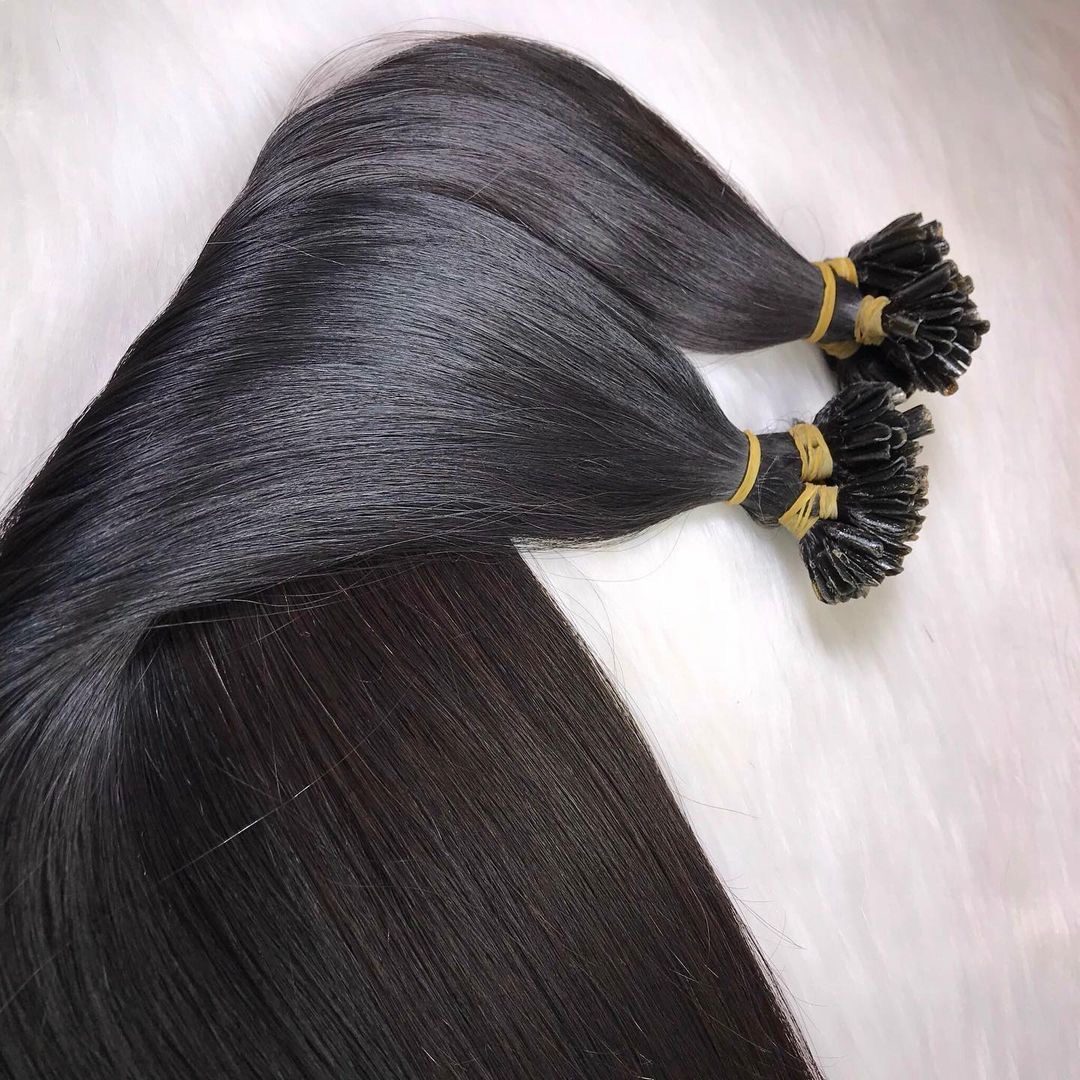
Keratin tips are attached one small strand at a time using a keratin bond at the root. U-tips are heat-bonded, where the stylist melts the keratin against a section of natural hair. I-tips are secured cold, clamped inside a micro-bead with no heat. A full head runs roughly 100 to 180 strands and takes about 3 to 4 hours, though both figures vary with head size and the stylist’s pace.
Removal is the part buyers underestimate. The bonds are dissolved with a keratin removal solution, not pulled out, and then the whole set is reinstalled once the bonds have grown 2 to 3 inches from the scalp, roughly every 3 to 4 months as industry convention. That solvent step is chair time and product cost the salon absorbs at every cycle. Keratin tip extensions in I, U, V, flat and nano shapes cover most fusion install styles a salon will run.
How are tape-ins applied and removed?
Tape-ins sandwich a thin section of the client’s natural hair between two adhesive-backed wefts. Install is quick, usually 1 to 2 hours, and the flat panel sits close to the scalp. Because the adhesive spreads weight across the tape’s surface instead of hanging it from a single bond, stylists reach for tape-in extensions on fine and medium hair where a heavy anchor point would show.
Stylists typically reposition tape-ins every 6 to 8 weeks as the natural hair grows and the tapes drift down. Removal uses a remover solution to release the adhesive cleanly, after which the same hair can often be re-taped. Super double drawn hair performs best here because the ends stay thick through repeated removals and re-taping.
How are hand-tied wefts applied and removed?
Hand-tied wefts are horizontal strips of hair sewn onto a foundation of beads and thread, a setup stylists call a beaded row. The weft is thin, has no bulky seam, and lays close to the scalp, which is why hand-tied wefts are a fine-to-medium-hair favorite. No heat and no adhesive touch the hair itself, though the beaded foundation does hold sustained tension.
Maintenance means moving the row up every 6 to 8 weeks as the natural hair grows, which involves unpicking the thread and re-sewing the weft higher. That is straightforward chair time with no solvents. For thicker or coarser clients who need more volume and durability, a machine weft with its single continuous seam is the tougher alternative, though it sits heavier than a hand-tied row.
Which lasts longer, keratin tips or tape-ins?
Keratin tips stay in longer per install, about 3 to 4 months, while tape-ins are repositioned every 6 to 8 weeks. But per-install wear time is not the same as how long the hair itself survives. Tape-in hair can be re-taped 3 to 4 times for roughly 6 months of total service, and hand-tied weft hair can be reused for 6 to 12 months with maintenance. Keratin fusion hair has more limited reuse because the bonds are consumed at removal.
So the honest ranking depends on the question. If a client wants the fewest salon visits per install, keratin tips lead. If a buyer wants the hair to earn the most service life across reapplications, wefts and tape-ins are the stronger investment. These lifespan figures are care-dependent industry estimates, not guarantees.
Are keratin tips or tape-ins more damaging?
Both apply sustained tension, so neither is damage-free, and the difference is smaller than vendors imply. In the professional risk ranking, keratin fusion sits in the higher-risk band because the bonds hold weight continuously for months, while tape-ins sit in the moderate band because the load spreads across a flat panel. Hand-tied wefts also fall in the moderate band. This is professional consensus about the mechanism, not a single cited statistic.
The mechanism is the citable part: sustained pulling and added weight raise traction risk, and that is derivable from dermatology sources. The American Academy of Dermatology warns that “the constant pulling can cause strands of hair to break or fall out, and it could damage your hair follicles. Once the hair follicles are damaged, your hair cannot grow back, leading to permanent hair loss.” Traction alopecia can be permanent, though caught early, at the stage of redness, tenderness, or breakage at the hairline, it is reversible. Whatever method a salon runs, tension management is the real safety lever.
How long should a client wear these before a break?
Dermatologists recommend wearing extensions for two or three months at most, then giving the hair a break by switching to a style without them. That AAD cadence is stricter than the 3 to 4 month wear window keratin fusion is often marketed at, so it is worth flagging to clients. The AAD does not break the figure down by method, so treat it as a general rest-period guideline rather than a per-method rule. The practical line to pass along: if a style hurts or causes a headache, it is too tight, and the stylist should loosen the affected area.
Which should a wholesale buyer stock?
Stock to your clients’ hair types and their tolerance for maintenance, and weight toward the reusable methods that generate repeat sales. If your salons serve mostly fine and medium hair, tape-ins and hand-tied wefts are the core of the order because they lay flat and reuse well. If you serve dense, coarse hair that can hide bonds, keratin tips blend cleanly and command premium installs.
For resellers, reusability is cash flow. Tape-in and weft clients come back for maintenance hair and repositioning appointments, which turns one sale into a relationship. Keratin fusion sells at a premium but retires faster, so it is a higher-frequency reorder with a different rhythm. Many buyers carry all three and let the stylist match the method to the head, which is the position we would take.
FAQ
Can keratin, tape, and weft extensions all be reused?
Tape-ins and wefts reuse well; keratin tips are more limited. Tape-in hair can typically be re-taped 3 to 4 times for around 6 months of service, and hand-tied weft hair can be reused for 6 to 12 months with maintenance. Keratin fusion hair has limited reuse because the bonds are dissolved and consumed at removal. All reuse figures are care-dependent industry estimates.
Which is cheaper to maintain: keratin, tape, or wefts?
Maintenance cost tracks chair time and products, not just the hair. Keratin fusion needs a solvent to dissolve bonds at every full reinstall (roughly every 3 to 4 months), which adds product cost. Tape-ins need a remover solution and re-taping every 6 to 8 weeks. Wefts are simply unpicked and re-sewn every 6 to 8 weeks with no solvents, which often makes them the lightest-touch maintenance of the three. We do not quote prices publicly; pricing and MOQ are shared on WhatsApp.
Tape-in or weft for fine hair?
Both suit fine hair because they lay flat and spread weight, so the choice comes down to install style. Tape-ins are faster and fully adhesive, good for quick volume and length. Hand-tied wefts sit on a beaded row and can be moved up without solvents, good for clients wanting a sewn, more permanent feel. Keep tension light either way, since fine hair shows traction stress first.
Are keratin tip extensions worth it for thick hair?
Yes, keratin tips are a strong match for dense or coarse hair because individual bonds hide easily within the volume and blend seamlessly. Thick hair also anchors the bonds comfortably, which is not always the case with fine hair. Expect a 3 to 4 hour install for a full head of 100 to 180 strands and a full reinstall roughly every 3 to 4 months.
Talk to Nova Hair Factory
Nova Hair Factory manufactures keratin tips, tape-ins, and hand-tied and machine wefts from 100% Vietnamese single-donor raw hair, so you can carry all three methods from one supplier. To compare quality, get stock videos, or see a bleach test run on camera before you pay, message us on WhatsApp at +84 36 216 7992. Pricing and MOQ are shared there.