 Nova Hair
 What Is 613 Blonde Hair (and How It's Made)
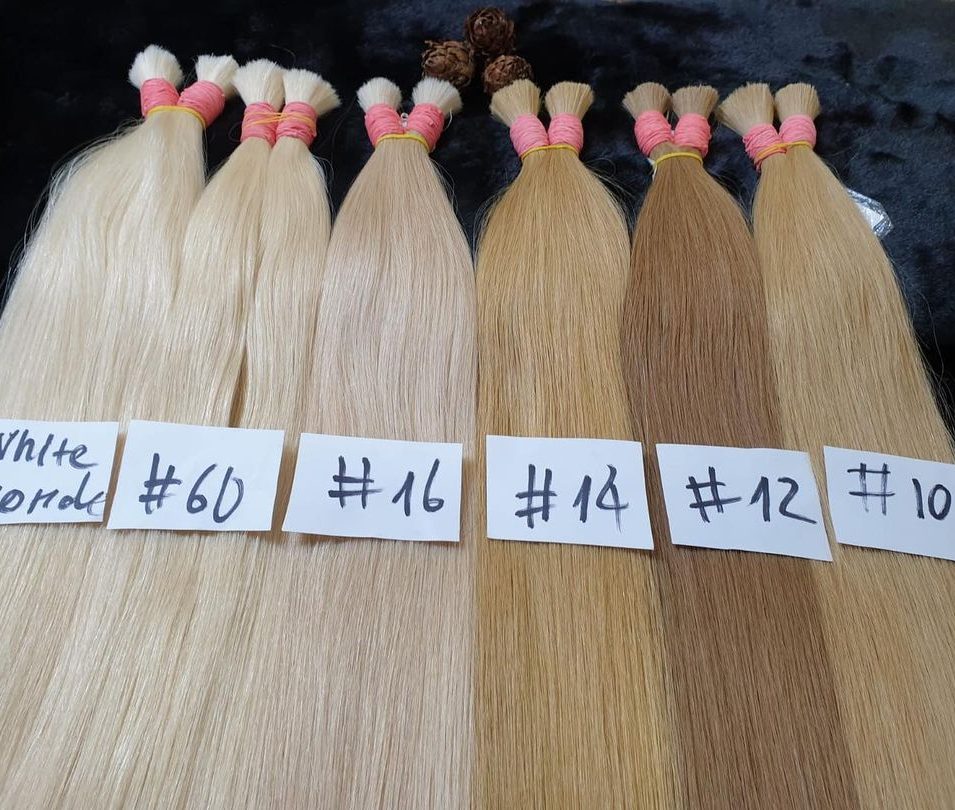
If you sell hair, “613” is a code you quote constantly, but most buyers never learn what the number actually stands for or why clean 613 costs more to produce. This is the identity and the chemistry of the lightest blonde in the trade, written for the people who buy it by the kilo.
What does 613 mean in hair colour?
613 is the extensions and wig industry’s colour code for the lightest platinum-to-golden blonde, roughly level 9 to 10 on the universal hair-colour scale. It is not a formal level number itself. The trade converged on 613 as shorthand for the palest blonde a bundle can reach, which is why you see it stamped on raw bundles, weaves, closures, and wigs alike.
Think of 613 as a destination rather than a single fixed shade. Some 613 leans cool platinum, some leans warm golden, and both still get labelled 613 because the term describes the lightness band, not one exact tone. When a buyer asks whether your 613 is “platinum or golden,” they are really asking where on that band your particular batch sits and whether it has been toned.
What number is 613 on the hair level chart?
613 sits at roughly level 9 to 10 on the professional hair-colour level system, the lightest end of the scale. Colourists classify natural hair depth on a numeric scale where 1 is the darkest black and 10 is the lightest blonde, and each whole number is one “level.” Some brands extend the scale to 11 or 12 for high-lift super-blondes. That 1-to-10 framework is documented in the International Colour Chart used across professional hairdressing and echoed in manufacturer colour education.
One caveat worth keeping straight when you talk to suppliers: 613 is not literally “level 613” on that chart. The 1-to-10 level system and the 613 code are two different naming conventions that happen to describe the same pale-blonde territory. Treat 613 as “lightest blonde, roughly level 9 to 10” rather than an exact standardised number, because no lab defines it as a single constant.
Where does the “613” numbering come from?
The 613 code borrows the logic of the salon colour system, where the digits before and after a dot carry meaning. In International Colour Chart notation, a code like 7.3 reads as level 7 depth plus tone 3, and in the common European tone system the tone digits run .1 ash, .2 violet, .3 gold, .4 copper, .5 mahogany, .6 red, .7 chestnut. American brands often swap in letters instead, such as A for ash and G for gold.
Tone-digit meanings shift slightly between manufacturers, so read 613 as an industry-standard label rather than a precise formula. What matters for a reseller is the shared understanding: across vendors, “613” means the same lightest-blonde target, which is exactly why it became the common tongue of the wholesale blonde market.
How is 613 hair made?
613 is made by lightening pigmented human hair until nearly all of its natural colour is oxidised away, then usually toning the result to a clean blonde. The lightening step is destructive oxidation of melanin, the pigment that gives hair its colour. There is real chemistry underneath this, and understanding it explains why some 613 comes out soft and even while cheaper 613 comes out patchy or damaged.
Cosmetic hair lightening relies on destructive oxidation of melanin pigments by hydrogen peroxide under alkaline conditions, according to peer-reviewed work from the University of York published via ScienceDirect in 2017. Alkaline pH, supplied by ammonia or monoethanolamine, is needed to deprotonate the hydrogen peroxide and generate the perhydroxyl anion, which that study describes as an important oxidant of melanin. The alkali does a second job at the same time: it swells and lifts the cuticle scales and opens the hair fibre, which the same source calls the first necessary step of any bleaching process.
Once the oxidant reaches the pigment, it decolourises melanin by breaking the pigment’s light-absorbing bonds. Work in the ACS Journal of Chemical Education (2025) and a Chemistry LibreTexts module from a Duke University course (2022) describe how hydrogen peroxide destroys melanin’s chromophoric bonds, the conjugated structures responsible for absorbing visible light, so the pigment turns colourless. Persulfate boosters in bleach powder decompose into sulfate radicals that further break down melanin’s conjugated bond system, which is how a formula reaches greater lift than peroxide alone.
Why is clean 613 so hard to reach?
Clean 613 is hard to reach because hair carries two kinds of melanin that lift at different rates. Natural colour comes from eumelanin, the brown-black pigment, and pheomelanin, the red-yellow pigment. Eumelanin breaks down first, so lightening dark hair passes through red, then orange, then yellow. Pheomelanin, the warm pigment, resists longest and is the last to clear, which is why pale yellow is the final stage before a strand reaches white or platinum.
That single fact explains most of the quality gap in the blonde market. To hit a clean, even 613 the process has to clear that residual warmth, and the palest 613 is usually toned to neutralise the last of the yellow. Push too hard to force the warmth out and the fibre over-processes and turns gummy. Stop too early and the bundle stalls at brassy orange-yellow. The narrow window between those two failures is why genuinely clean 613 commands a premium, and why a batch that lifts evenly is a mark of good starting material and controlled processing.
Does raw or virgin hair lift to 613 better than processed hair?
Cuticle-intact raw and virgin hair enters the lightening process undamaged and with no prior colour to fight, which fits the way bleaching chemistry actually works. Because the alkali has to lift the cuticle first before the oxidant can reach the pigment in the cortex, hair that arrives with its cuticle aligned and never chemically altered starts the lift from a cleaner baseline than hair that has already been coloured, coated, or stripped once before.
We frame this as process rationale, not as a laboratory finding, because no single study says “raw cuticle-intact hair lifts to 613 more cleanly.” What the chemistry does support is straightforward: undamaged structure and no competing artificial dye mean fewer variables working against an even result. At Nova Hair Factory our raw bundles are 100% Vietnamese single-donor human hair, cuticle-aligned and unprocessed, and they lift to 613 in one bleach session. Vietnamese hair is prized in the trade for its strength, cuticle alignment, and clean lift to blonde, and with proper care raw Vietnamese hair can last one to three years.
If you want to verify a supplier’s 613 for yourself, the bleach test is the industry’s reliable authenticity check. We keep the full method separate so this guide stays focused on identity and chemistry: see the 613 bleach test protocol for exactly how to run it and read the result.
Can you dye 613 hair any colour?
Yes, and that flexibility is the main commercial reason 613 exists as a stock item. Because 613 has already had its natural pigment lightened away, it acts as a blank canvas that takes almost any deposit colour without needing to be pre-lightened again. A reseller can hold 613 in inventory and turn it into pastels, vivids, rooted blondes, or custom brand shades on demand, which is far more efficient than stocking every finished colour separately.
That is also why a Nova colour collection is built on top of clean 613 blonde as a base. The cleaner and more even the starting 613, the more predictable every colour you lay over it becomes, so the quality of the base blonde directly sets the ceiling on every dyed shade you sell afterward.
Frequently asked questions
Is 613 human hair or synthetic?
613 can be either, which is exactly why buyers test it. In the raw and virgin market, 613 is real human hair that has been lightened. Low-grade “613” sometimes hides synthetic or mixed-origin filler strands that will not lift evenly, which the bleach test exposes.
Why is 613 hair more expensive?
613 costs more because it takes the most processing and the best starting material to reach cleanly. The narrow window between under-lifting to brassy and over-lifting to gummy means only good hair, carefully processed, produces even 613 that stays soft.
Is 613 platinum or golden blonde?
Both fall under 613. The code describes the lightest blonde band, so 613 can present as cool platinum or warm golden depending on how far the warmth was cleared and whether the hair was toned afterward.
What is the difference between 613 and regular blonde hair?
613 is the lightest blonde level, roughly 9 to 10, whereas “regular” blonde covers darker levels that still hold visible warmth. 613 is the near-white base that other blondes and colours are built from.
Talk to the factory
Nova Hair Factory sorts, washes, wefts, and colours hair in its own workshop in Bắc Ninh, Vietnam, and we film a bleach test on camera before payment. To see current 613 stock, request a live factory video call, or talk pricing and MOQ, message us on WhatsApp at +84 36 216 7992. Browse the virgin raw bundles that lift to 613 in one session, or the finished colour collection built on that base.